
11 May 2026 | Monday | Interaction
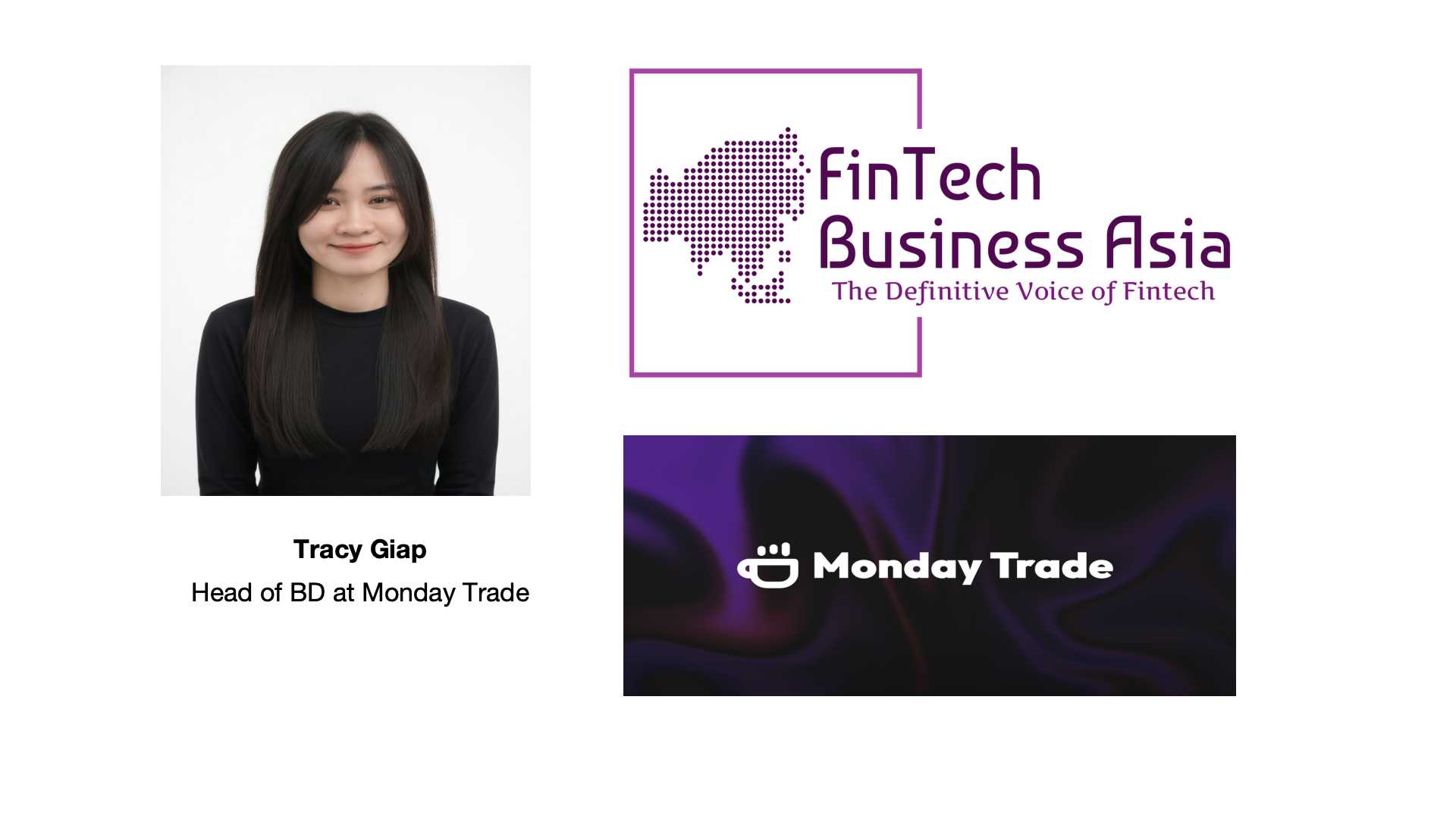
As tokenized real-world assets continue to gain momentum across global financial markets, decentralized trading platforms are increasingly positioning themselves at the intersection of traditional finance and blockchain innovation. In this conversation with Fintech Business Asia, Tracy Giap Head of BD at Monday Trade shares how Monday Trade is leveraging the high-performance infrastructure of Monad to bring Nasdaq-listed equities on-chain, enable near-instant settlement, and build a more accessible and transparent financial ecosystem. Cai also explores the growing institutional adoption of tokenized RWAs, the importance of compliance and proof-of-reserves frameworks, and the evolving regulatory landscape shaping the future of decentralized capital markets.
Q: Monday Trade is positioning itself as a bridge between traditional finance and DeFi—what strategic vision drove the decision to bring Nasdaq-listed stocks on-chain via the Monad network?
A: Traditional finance (TradFi) offers valuable, trusted assets, but operates on outdated and geographically restrictive infrastructure. On the other hand, DeFi (Decentralized Finance) enables global accessibility and composability, but still lacks mainstream financial products people already know and want to access.
Our vision with Monday Trade is simple and focused, and that is to help bridge that gap. We believe that tokenized equities represent one of the clearest paths toward connecting traditional finance with decentralized finance in a meaningful way.
By bringing Nasdaq-listed stocks on-chain, we’re making familiar assets and stocks more accessible to anyone within a decentralized ecosystem and moving toward a future where financial markets are on-chain.
More broadly speaking, we believe that the future of finance is on-chain. Finance access should not be limited by geography, market hours, account access, or legacy infrastructure. Over time, all major traditional financial assets will become globally accessible through blockchain-based systems and platforms.
Choosing Monad was a strategic choice for us as it aligns with that exact vision. While it is an emerging network and still only roughly ~5 months old, Monad has positioned itself as the global blockchain Layer-1 network for developers to build on, with high-performance architecture, speed, and scalability to create the foundation needed for institutional-grade financial products to operate efficiently in a decentralized environment.
For us, it’s imperative to build on infrastructure capable of supporting the next generation of onchain capital markets, whilst still delivering the user experience traders expect from modern and CEX finance platforms.
On Monday Trade, tokenization represents a structural shift in how financial markets operate in the years to come. Just as the internet digitized information, blockchain technology is digitizing ownership and financial access. RWAs are one of the first major examples of traditional finance moving toward internet-native infrastructure.
The growing demand for tokenized assets also reflects changing expectations from global users, showcasing that the tokenized RWA market grew by over 256% in just 15 months, increasing from $5.4 billion at the beginning of 2025 to more than $19.3 billion by March 2026 (source: CoinGecko).
Not only that, RWA.xyz also highlights critical data showing real-world assets exceeded $27 billion in distributed on-chain value in 2026, demonstrating the accelerating institutional and retail adoption of tokenized finance (source: RWA.xyz)
Younger and digitally native investors expect financial products to be accessible, transparent, and available online without unnecessary intermediaries or geographic restrictions.
In many ways, the next phase of growth for RWAs will depend not only on technological innovation but also on the ability of platforms, issuers, and regulators to collaboratively establish standards that support both innovation and consumer protection.
Q: How does the platform ensure trust and transparency for investors when offering 1:1-backed tokenized stocks with on-chain settlement and self-custody?
A: Trust and transparency are foundational to how we approach tokenized equities on Monday Trade. Our partnership with Anchored Finance has grown and plays a central role in providing the framework for compliant and verifiable real-world asset issuance.
All RWA assets listed on Monday Trade are issued by Anchored and are backed 1:1 through its licensed broker partnership with Alpaca. These are not synthetic assets or derivatives. Each on-chain token directly corresponds to an underlying custodial share.
A key part of this transparency model is Anchored’s Proof of Reserves system. The underlying shares are held through a licensed U.S. broker-dealer, and the reserves are independently verified to ensure that the number of shares held matches or exceeds the total token supply on-chain. This information is then published publicly so anyone can verify that all tokens are fully backed at all times.
Transparency is further strengthened through on-chain settlement, where transactions and asset movements can be independently tracked and verified on the blockchain in real-time. Unlike traditional financial systems, where much of the infrastructure and information operate behind closed systems, blockchain-based settlement creates a more transparent and auditable record of activity for anyone to see.
Self-custody is also crucial to us. Unlike traditional brokerage platforms, where assets are controlled by intermediaries, users can hold tokenized assets directly in their own Web3 wallets, giving them greater ownership and control over their assets & portfolio.
Q: With 24/5 trading and near-instant settlement, how do you see tokenized equities reshaping traditional market structures and trading behaviors?
A: Tokenized equities have the potential to modernize many of the inefficiencies and struggles that still exist in traditional financial markets, particularly when it comes to limited trading hours and delayed settlement systems like T+1.
Information moves instantly across the world, but traditional markets still operate within fixed time windows and legacy settlement infrastructure.
With 24/5 trading and near-instant settlement, investors can react to news, macro events, and market movements in real time rather than waiting for exchanges to reopen. This creates a more responsive and globally connected trading environment for traders that better reflects the pace of modern financial markets.
Tokenized markets also create the potential for more globally distributed liquidity, where users from different regions can participate within the same financial infrastructure more seamlessly than traditional exchange systems allow today. Instead of markets being fragmented by geography and operating hours, on-chain markets can move toward a more unified and continuously accessible trading environment.
We also believe faster settlement can help reduce operational friction and counterparty risk that still exist within legacy financial systems. Traditional settlement delays can create inefficiencies around capital allocation, transfers, and collateral management, whereas blockchain-based settlement infrastructure enables a more streamlined and transparent process.
For international users, especially, tokenized equities make access far more seamless, and this shift is highly impactful. While many can already access US stocks, they are still tied to traditional market hours. On-chain markets move toward a more flexible, always-on model that reflects how global investing operates today.
Q: What role does Monad’s high-performance infrastructure—such as high throughput and sub-second finality—play in enabling institutional-grade trading on a decentralized platform?
A: Monad’s high-performance infrastructure is a key part of delivering the best trading experience in a decentralized environment. With high throughput and sub-second finality, the network is designed to support fast execution, low latency, and near-instant settlement, all of which are critical for active trading markets.
For trading DEXs, performance and execution quality matter significantly. It becomes more crucial for market makers, trading desks, and algorithmic traders, where execution speed and settlement efficiency directly impact performance and liquidity.
While legacy blockchain networks have frequently faltered under the weight of congestion and lagging settlement times, Monad’s high-performance architecture is specifically engineered to overcome these traditional bottlenecks. This allows us to deliver the institutional-grade efficiency required for modern markets without compromising on the core principles of decentralized infrastructure.
Another critical factor is Monad’s EVM compatibility, which allows tokenized assets to integrate seamlessly with the broader DeFi ecosystem. Overall, this creates a greater composability for RWAs, enabling them to interact with other on-chain financial applications, liquidity infrastructure, and trading protocols more efficiently.
As real-world assets continue to grow and continue to receive mainstream adoption, we believe infrastructure and performance will become increasingly important. Bringing institution-grade financial products on-chain requires blockchain networks that can support both scalability and real-time market activity without compromising the decentralized nature of the ecosystem.
Q: Given the rapid growth of tokenized real-world assets, what regulatory and compliance challenges do you anticipate as adoption scales globally?
A: As the tokenized RWA sector continues to grow globally, regulation and compliance will remain one of the industry’s most important challenges that we need to overcome, particularly as frameworks continue to evolve at different speeds across jurisdictions.
The opportunity around tokenized assets is enormous, but long-term adoption will depend on building infrastructure that can operate responsibly within emerging regulatory standards while still preserving the core benefits of decentralized finance.
Our approach is to balance the core principles of DeFi, such as openness and self-custody, with responsible compliance practices, designed to protect users and support sustainable growth. While decentralized finance is fundamentally global by nature, regulatory clarity is still uneven across different regions.
As of today, we restrict access from regions such as the US, China, and the Philippines, where regulatory uncertainty remains high. This is ultimately designed to protect both users and the platform while clearer frameworks continue to develop. We also work closely with Anchored Finance to ensure the tokenized assets offered on Monday Trade meet appropriate regulatory and issuance standards.
At the same time, the broader global direction for digital assets is becoming increasingly constructive. Frameworks such as MiCA in Europe, regulatory initiatives from Singapore’s MAS, the continued advancement of the U.S. Digital Asset Market CLARITY Act, and the evolving digital asset policies in regions like the UAE are helping create clearer pathways for innovation and responsible participation within the sector.
While regulation remains fragmented globally, the overall trend is moving toward greater clarity rather than away from it.
We also believe that proactive engagement is important. Rather than waiting for enforcement actions to define the boundaries of the industry, we believe platforms should actively build compliance infrastructure that can adapt and scale alongside evolving regulation. As clearer frameworks emerge across additional jurisdictions, we expect compliant access to tokenized RWAs to expand significantly over time.
Ultimately, our strategy is to grow responsibly, operate only where we can do so confidently, and continue building the infrastructure needed to support a scalable, transparent, and globally accessible on-chain financial system.



Fintech Business Asia, a business of FinTech Business Review
© 2026 FinTech Business Review. All Rights Reserved.