
18 May 2026 | Monday | Interaction
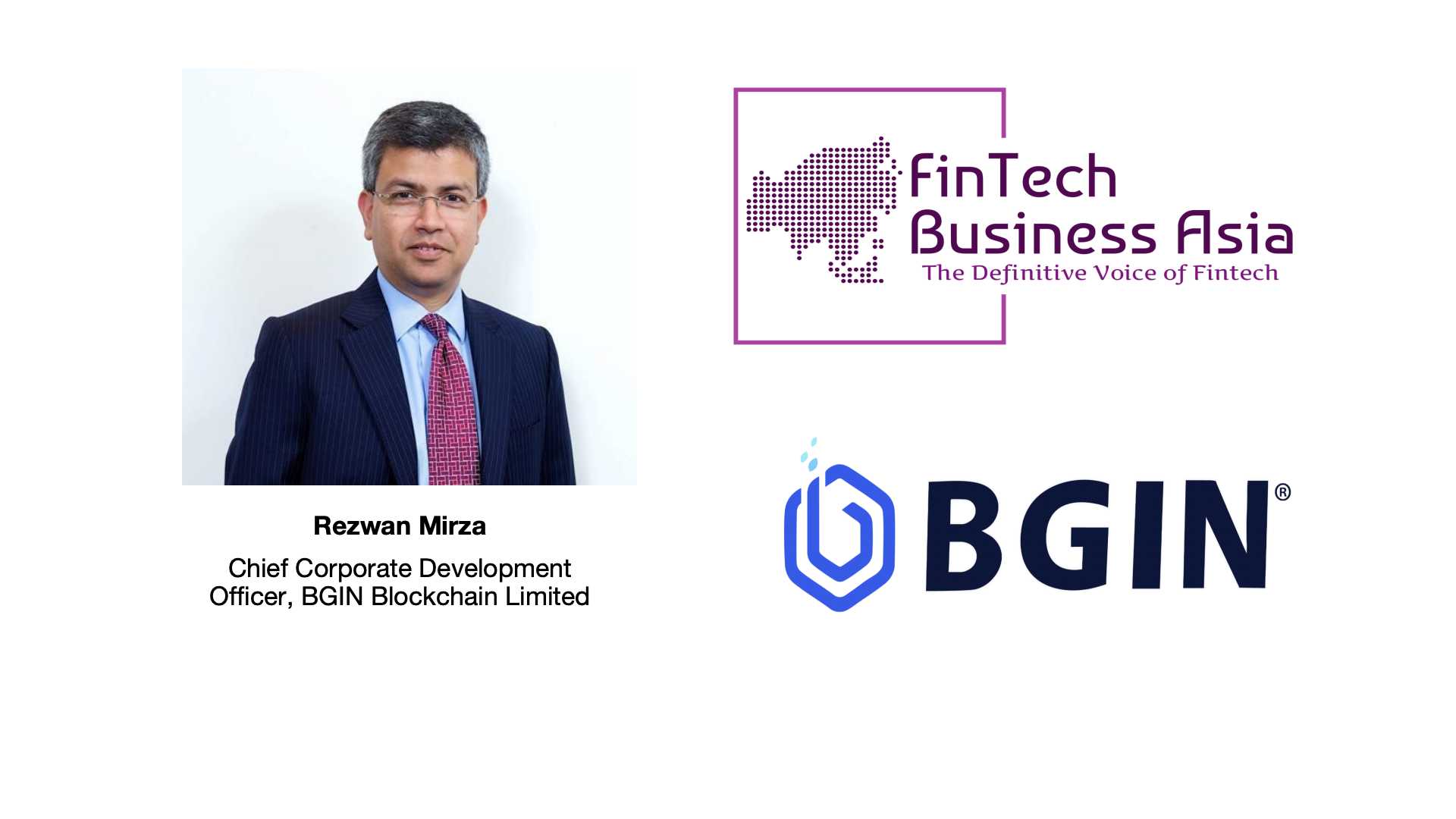
As Bitcoin mining evolves beyond industrial-scale operations, BGIN Blockchain Limited is exploring how consumer-oriented hardware could reshape access to the crypto ecosystem. Speaking with Fintech Business Asia, Rezwan Mirza, Chief Corporate Development Officer at BGIN Blockchain Limited, shared insights into the company’s PortableBTC prototype unveiled at Bitcoin 2026, the strategic importance of vertical integration in mining infrastructure, and why accessible mining experiences could coexist alongside large-scale industrial operations in the future digital asset economy.
Q: BGIN Blockchain Limited unveiled its PortableBTC prototype at Bitcoin 2026. What strategic role does this product play in your broader ambition to expand beyond industrial mining into consumer-oriented solutions?
A: Our ICERIVER® PortableBTC prototype (‘BT0’) reflects our view that over time, Bitcoin mining may not be limited to large industrial scale sites. We have always been sensitive to the needs of our mining customers, including the machine storage limitations some of them may face. As such, the prototype is also another step towards connecting our progress in Bitcoin ASIC development with a more accessible hardware form factor. It demonstrates how chip design, hardware engineering, system validation, and user experience can be integrated into a mining hardware platform.
We would like to emphasize that the PortableBTC prototype shown at Bitcoin 2026 is a limited, non-commercial prototype and is not for sale. It does not represent final production specifications. It is a commemorative and exploratory device intended to demonstrate BGIN’s ongoing work in Bitcoin ASIC development, hardware engineering, and mining system design.
Q: The PortableBTC prototype is positioned around your “Crypto for All” vision. How realistic is mainstream, at-home Bitcoin mining in Asia, given cost, regulation, and energy constraints across the region?
A: The real question is not whether every household will mine Bitcoin like an industrial operator. It is whether mining can become easier to understand and more accessible from a user experience perspective over time. From that perspective, we believe the concept is worth exploring.
Asia is not a single market. Energy costs, regulation, housing environments, consumer behavior, and access to mining infrastructure vary widely across the region. In some markets, at-home mining may be more educational, collectible, or community-driven. In others, more efficient and user-friendly devices could gradually support broader user engagement and educational use cases. Asia is a diverse and rapidly evolving region, and user preferences, infrastructure conditions, and regulatory environments vary significantly across different markets.
For consumer-facing mining hardware to become more practical, the industry needs to solve more than chip efficiency. Power consumption, heat, noise, safety, reliability, setup experience, and operating economics all matter. That is why we view this as a broader engineering and infrastructure challenge, not simply a hardware question.
Q: Your prototype is powered by the BT1 ASIC chip, highlighting in-house chip design capabilities. How critical is vertical integration — spanning chip design to infrastructure — in staying competitive in the global mining hardware race?
A: Vertical integration matters because Bitcoin mining economics are no longer determined by chip performance alone. ASIC performance matters, but real-world efficiency depends on how the chip, machine, thermal design, power infrastructure, and operating model work together.
Understanding and adapting to this paradigm shift is important as mining competes for power, infrastructure, and capital with other high-demand sectors, including AI and data centers. In that environment, efficiency becomes more than a technical metric. It has increasingly become a question of capital efficiency and infrastructure discipline.
For BGIN, the BT1 ASIC chip-powered PortableBTC prototype helps illustrate our ongoing chip development efforts, but the broader point is operational integration across hardware, infrastructure, and system design. Our experience across ASIC development, mining machine design and manufacturing under the ICERIVER brand, and mining infrastructure operations gives us practical insight into how performance, efficiency, and operating considerations interact across the mining lifecycle.
Q: The company emphasized that the PortableBTC (‘BT0’) is a non-commercial, early-stage prototype. What key milestones must be achieved before such a product can evolve into a viable commercial product?
A: For any consumer-facing mining device, moving from prototype to commercial product requires more than proving that the hardware can mine. The product has to be safe, stable, reliable, understandable, and practical for the intended user environment.
The first step is system-level validation. That means testing how the chip, power design, thermal structure, firmware, and enclosure perform together over time, not only under laboratory conditions. For consumer-facing hardware, stability, heat control, noise, and safety matter as much as raw hash rate.
The next step is further engineering refinement and validation. The ICERIVER® PortableBTC prototype (‘BT0’) is built from first-pass silicon and does not represent final production specifications. Any product in this category would need further work around power consumption, thermal performance, manufacturing consistency, ease of setup, and user experience.
There are also compliance, certification, quality control, support, and supply-chain requirements before any commercial hardware product can be responsibly introduced to the market.
For now, the PortableBTC prototype remains a limited, non-commercial prototype and is not for sale. We are currently focused on testing and system-level validation, and any future developments would be communicated through appropriate disclosure channels as applicable.
Q: During Bitcoin 2026, your leadership highlighted that mining competition is increasingly shaped by full-stack capabilities, including power infrastructure and operational efficiency. How is BGIN Blockchain Limited positioning itself against established global players on this front?
A: We see the industry moving from competition based primarily on hardware specifications to a broader focus on operational execution. Specifications still matter, but long-term competitiveness also depends on manufacturing quality, power access, infrastructure planning, deployment speed, operating discipline, and operational efficiency.
For BGIN, our approach is based on integrating hardware development, manufacturing, and infrastructure operations. We have experience in ASIC development, mining machine design and manufacturing under the ICERIVER brand, and mining infrastructure and hosting services. That experience helps us better understand how hardware performance, infrastructure conditions, and operational considerations interact in real-world mining environments.
At the same time, we recognize that this is a highly competitive global industry with well-established participants. Our focus is on continuing to strengthen operational execution over time — from chip development and system validation to manufacturing readiness, infrastructure operations, and customer-oriented hardware and infrastructure services. BGIN has successfully completed 7 ASIC tapeouts and has experience developing and manufacturing ICERIVER® mining hardware, which provides a foundation for continued engineering and operational development.
Q: As institutional and retail interest in digital assets grows across Asia, do you see portable or consumer-grade mining devices becoming a meaningful gateway into the crypto ecosystem, or will large-scale mining continue to dominate?
A: We do not see consumer-grade mining and large-scale mining as mutually exclusive. They serve different purposes and can coexist within the broader Bitcoin ecosystem.
Large-scale mining will continue to be central to securing the Bitcoin network. It is driven by industrial efficiency, access to power, infrastructure discipline, and operating scale.
Consumer-facing mining devices can serve a different purpose. They are not about replacing industrial mining; they are about making mining more visible and easier to understand. For many users, the first step into crypto is holding or trading digital assets. Mining can provide users with a more direct way to understand how Bitcoin network infrastructure operates.
That is broadly consistent with BGIN’s “Crypto for All” vision. In our view, the industry does not have to choose between industrial infrastructure and more accessible hardware experiences. Both can continue to play different roles within the broader Bitcoin mining landscape.





Fintech Business Asia, a business of FinTech Business Review
© 2026 FinTech Business Review. All Rights Reserved.